
Why Getting Some Sun Might Be the Best Health Decision You'll Make This Year (And It's Not What You Think)
I'm about to share something that might make you question everything you've been told about sun exposure.
And honestly?
It should.
Because while everyone's hiding indoors slathering on SPF 50 like it's going out of style, there's a growing body of research suggesting we might have this whole sun thing backwards.
Here's what caught my attention: A groundbreaking Swedish study followed nearly 30,000 women for 20 years and found something remarkable.
Women who actively sought sun exposure - even if they smoked - had similar health outcomes to non-smoking women who avoided the sun entirely.
Let that sink in for a moment. 🤯
The sun-seeking smokers were as healthy as the sun-avoiding non-smokers.
Now, before you light up a cigarette and head to the beach (please don't!), let me explain what this really means for busy parents like you who are trying to optimize their health without adding another complicated protocol to their already packed schedules.
Because here's the thing - we've been so focused on avoiding skin damage that we've forgotten about all the incredible benefits our bodies get from that big, bright ball of energy in the sky.
And if you're feeling tired, moody, or like your energy levels are stuck in neutral, the solution might be simpler than you think.
The Vitamin D Connection: Your Body's Solar Power System
Here's what most people don't realise about vitamin D - it's not actually a vitamin at all.
It's a hormone.
And like all hormones, when it's out of whack, everything else follows.
When your skin is exposed to UVB rays from the sun, your body starts producing vitamin D3 in a process that's been fine-tuned over millions of years of human evolution.
This isn't some newfangled health hack - this is how we're designed to function.
But here's where it gets interesting for parents who are juggling work, kids, and trying to squeeze in some semblance of self-care.
Adequate vitamin D levels don't just affect your bones (though they do that too).
They impact:
Your energy levels throughout the day ⚡
Your mood and mental clarity 🧠
Your immune system's ability to fight off whatever the kids bring home from school 🛡️
Your sleep quality (yes, morning sun exposure helps you sleep better at night!) 😴
Your body's ability to absorb other nutrients properly
Think of vitamin D as your body's master switch.
When it's working properly, everything else has a better chance of working properly too.
And while you can get some vitamin D from supplements, your body produces it more effectively and uses it more efficiently when it comes from actual sun exposure.
It's like the difference between eating a whole orange versus popping a vitamin C tablet.
Both technically give you vitamin C, but your body knows what to do with the orange.
The Seed Oil Connection: Why You're Burning When You Shouldn't Be
Now here's where things get really interesting - and where most health advice completely misses the mark.
If you're someone who burns easily in the sun, your first instinct is probably to blame the sun itself.
But what if I told you the problem might actually be what's on your plate?
Here's what's happening inside your body:
When you consume high amounts of seed oils (we're talking canola, soybean, corn, sunflower, safflower oils - basically everything that's in processed foods), these oils get incorporated into your cell membranes.
These oils are highly unstable when exposed to heat, light, and oxygen.
Sound familiar? 🌞
So when UV rays hit your skin, these unstable oils in your cell membranes start to oxidize and create inflammation.
That inflammation? That's what we call sunburn.
Think about it - our ancestors spent entire days outdoors without SPF 100 and somehow managed to survive and thrive.
They weren't some special breed of sun-resistant humans.
They just weren't eating inflammatory seed oils with every meal.
Instead, they were eating foods rich in natural antioxidants and stable fats that actually protected their skin from the inside out.
Foods like:
Wild-caught fish rich in omega-3s
Grass-fed meats with natural vitamin E
Colourful fruits and vegetables packed with protective compounds
Nuts and seeds that hadn't been processed into inflammatory oils
This doesn't mean you should go bake yourself on the beach for hours on day one.
But it does mean that if you clean up your diet first, you might be surprised at how much sun your skin can actually handle.
And how much better you feel when you get it.
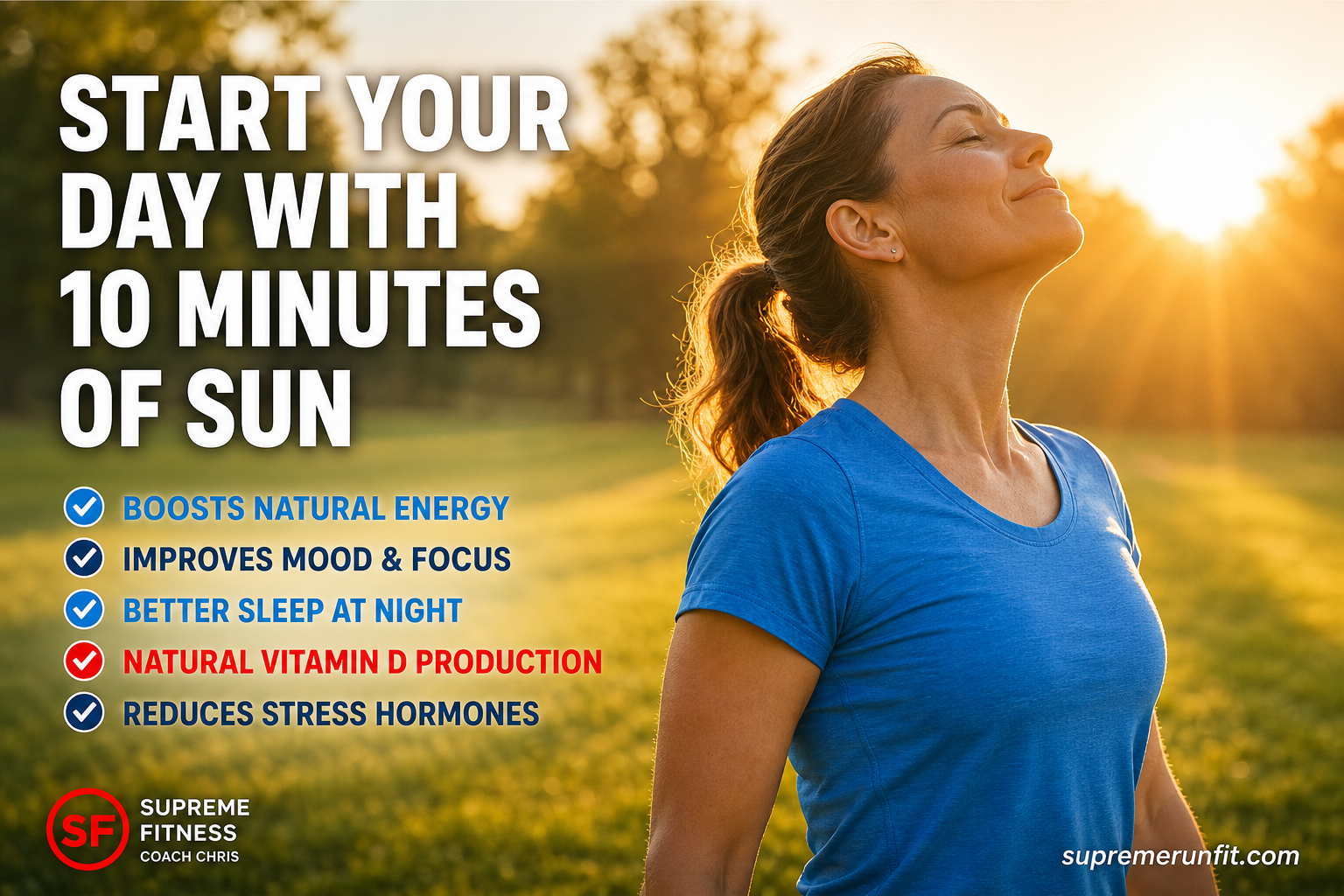
Morning Light: Your Natural Energy Reset Button (And Why Those Sunglasses Are Working Against You)
Here's something that might change how you think about your morning routine forever.
The light that hits your eyes in the first hour after waking up doesn't just help you see.
It literally sets your body's master clock for the entire day.
I'm talking about your circadian rhythm - the internal system that controls when you feel alert, when you get hungry, when your body temperature rises and falls, and when you naturally want to sleep.
And here's the kicker: artificial indoor lighting isn't bright enough to properly set this system.
You need actual sunlight.
Not through a window (glass blocks the specific wavelengths you need).
Not from a light therapy box (though those can help in winter).
And definitely not while wearing sunglasses.
You need direct sunlight hitting your retinas.
Here's why those designer shades might be sabotaging your health:
When sunlight hits your eyes, it triggers your brain to send signals throughout your body to start producing melanin - your body's natural sunscreen.
Think about that for a second.
Your body literally makes its own SPF, but only when it gets the signal from your eyes that sun exposure is coming.
When you wear sunglasses, you're blocking that crucial signal.
So your skin is getting UV exposure, but your brain doesn't know to ramp up melanin production.
Result? You burn more easily and miss out on all the protective benefits your body is designed to provide.
This is why people who spend lots of time outdoors without sunglasses often develop beautiful, even tans and rarely burn, while the weekend warriors who slap on shades and hit the beach end up looking like lobsters.
Here's what happens when you get 10-15 minutes of morning sun exposure (sunglasses-free):
Your brain stops producing melatonin (the sleepy hormone) and starts ramping up cortisol production in a healthy way.
This cortisol spike isn't the stressed-out, chronic kind that comes from deadlines and traffic jams.
This is your body's natural "time to be awake and alert" signal.
It's like hitting the reset button on your energy levels.
But wait, there's more (I know, I sound like an infomercial, but stick with me! 😄).
That morning light exposure also triggers the production of serotonin - your feel-good neurotransmitter.
More serotonin during the day means better mood, clearer thinking, and here's the bonus - better sleep at night.
Because in about 12-14 hours, your body will convert some of that serotonin into melatonin, helping you fall asleep naturally.
And it primes your skin's natural defense system for any sun exposure later in the day.
For busy parents juggling a million things, this isn't just nice-to-know information.
This is a simple, free way to improve your energy, mood, sleep quality, AND your skin's ability to handle sun exposure - all at once.
No supplements required.
Just step outside without the shades for a few minutes each morning.
Evening Light: The Gentle Wind-Down Your Body Craves
Now, if morning light is your body's wake-up call, evening light is its gentle lullaby.
And this is where most of us are completely sabotaging our sleep without even realising it.
Here's what should happen as the sun starts to set:
The changing light spectrum (those beautiful oranges and reds) signals to your brain that it's time to start winding down.
Your cortisol levels naturally begin to drop.
Your body temperature starts to lower slightly.
And your brain begins the process of converting serotonin into melatonin.
But instead of following this natural rhythm, what do most of us do?
We flip on bright overhead lights, stare at blue screens, and then wonder why we're wide awake at 11 PM scrolling through social media. 🤦♂️
Here's a simple evening routine that works with your biology instead of against it:
Step 1: Try to catch 10-15 minutes of that golden hour light outside.
No sunglasses needed - you want those sunset wavelengths hitting your eyes.
Step 2: As darkness falls, dim your indoor lights significantly.
Think cozy restaurant lighting, not operating room brightness.
Step 3: If you must use devices, use blue light blocking glasses or enable night mode.
Better yet, try reading an actual book or having real conversations.
I know this sounds almost too simple to work.
But remember - your body has been following these light cues for thousands of years.
We've only been fighting against them for the last century or so.
For parents especially, this evening routine can be a game-changer.
Not only does it help you wind down from the chaos of the day, but it also models healthy sleep habits for your kids.
Plus, there's something deeply satisfying about watching a sunset that no amount of Netflix can replicate.
It's like your soul's way of saying "okay, we did good today, time to rest."
Your Simple Sun Strategy: Making This Work in Real Life
Alright, let's get practical.
Because knowing all this science is great, but if you can't fit it into your already packed schedule, it's just interesting trivia.
Here's how to start getting these sun exposure benefits without overhauling your entire life:
Morning Sun (5-10 minutes):
Step outside while your coffee brews ☕
Walk to the mailbox or around the block
Eat breakfast on the patio when possible
Park a bit further from work and walk the extra distance
Throughout the Day:
Take phone calls outside when you can
Choose the outdoor table at restaurants
Walk during your lunch break instead of scrolling your phone
Play with the kids in the backyard instead of just watching from inside
Evening Wind-Down (10-15 minutes):
Make sunset viewing part of your family routine
Take an evening walk around the neighborhood
Sit on your porch or balcony as the day winds down
Important reminders:
Start slowly - don't go from zero sun exposure to hours outside
Your skin tone, season, and location all matter for timing
Listen to your body and build tolerance gradually
You're not trying to get a tan, just gentle, consistent exposure
The Swedish study I mentioned earlier?
Those women weren't sunbathing for hours.
They were simply living more of their lives outdoors.
And that made all the difference.
Look, I get it.
As busy parents, you're already trying to juggle healthy eating, exercise, quality time with kids, work demands, and maybe - if you're lucky - a few minutes for yourselves.
The last thing you need is another complicated wellness protocol.
But this isn't complicated.
This is just stepping outside.
And if you're ready to take this simple concept and turn it into a complete morning and evening routine that sets you up for better energy, mood, and sleep, I've got something that might help.
Ready to Rise and Prime your days for success?
I've created a simple guide that shows you exactly how to use natural light, along with other science-backed strategies, to optimise your energy and mood throughout the day.
Download your free Rise and Prime guide here →
Because you deserve to feel energized, focused, and ready to tackle whatever your busy life throws at you.
And sometimes, the most powerful solutions are also the simplest ones.
Step outside. ☀️
Your body - and your family - will thank you for it.